Camino de Santiago. All you need to know
Автор: Игорь
The Camino de Santiago is a network of historic pilgrimage routes across Europe leading to the Cathedral of Santiago de Compostela in northwest Spain. It has been walked for over 1,000 years and is recognised as a UNESCO World Heritage Site. The most popular route is the Camino Francés (46% of pilgrims in 2025), and the minimum distance to receive the Compostela certificate is 100 km walking or 200 km cycling. In 2025, 530,919 pilgrims received their Compostela in Santiago — a record number, according to the Pilgrim’s Office.
Key facts block :
- Type: Network of pilgrimage routes (10+ official routes)
- Destination: Cathedral of Santiago de Compostela, Galicia, Spain
- Total length: From 75 km (Celtic Camino) to 1,000+ km (Via de la Plata)
- Most popular route: Camino Francés — 780 km, ~46% of pilgrims
- Minimum for Compostela: 100 km on foot / 200 km by bike
- Pilgrims in 2025: 530,919 Compostelas issued
- UNESCO status: World Heritage Site since 1993
- Best months to walk: April–June and September–October
Imagine stepping onto ancient paths where every footstep echoes with centuries of history. The Camino de Santiago, or the Way of St. James, is more than a walking route—it’s a profound journey of discovery, spirit and connection.
For over 1,000 years, pilgrims have travelled these trails to the magnificent Cathedral of Santiago de Compostela in Galicia, northwest Spain, believed to be the resting place of St. James the Apostle. The city itself takes its name from him—Santiago meaning St. James and Compostela meaning field of stars.
Recognised as a UNESCO World Heritage Site, the Camino is a living crossroads of cultures, uniting walkers, cyclists and dreamers from all over the world.
Nowadays, the Camino de Santiago transcends a mere pilgrimage; it’s a once-in-a-lifetime experience. With its diverse Camino routes, this journey draws thousands from across the globe, offering a unique and unforgettable adventure.
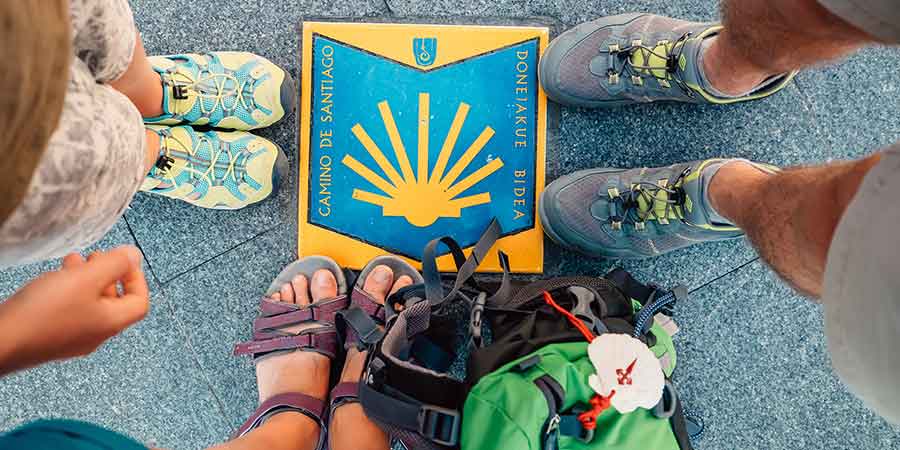
There is no singular starting point for the Camino de Santiago. There are many different routes to Santiago and, in turn, many starting points. Your route depends entirely on your preferences and interests and what you want to get out of the experience.
The reason for the huge variety in starting points is that the original pilgrims would have commenced their Camino journeys from their own homes. So that’s why so many different Camino ways have emerged over the centuries.
Despite this, there has been a clear favourite among the routes. The Camino Frances, also known as the French Way, is the most famous and popular of the Camino routes. Due to this, Sarria, located 100km from Santiago, is the top starting point for pilgrims.
The Camino Portugues Coastal is the second most popular route, especially the last 100km starting in Vigo. If you are curious about our other popular starting points, make sure to have a look at our last 100km Camino collection.
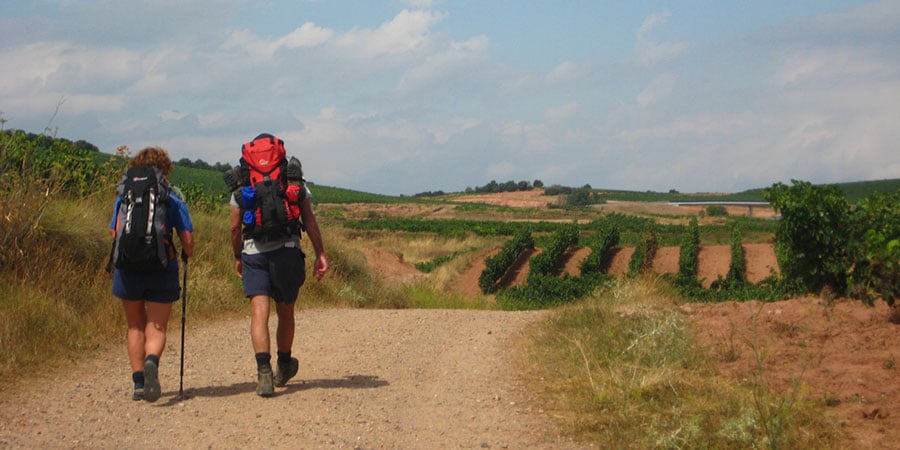
The Camino de Santiago routes are a network of many different paths, all leading pilgrims to the city of Santiago de Compostela. Each route has its history, heritage and charm, and there is a route for every interest and ability.
Choosing the most suitable Camino walk for you is essential for you to make the most of this memorable experience. To help you decide, we have a guide to choosing your perfect Camino, and you can also discover the experiences of previous pilgrims.
Each year, the Pilgrim’s Office in Santiago lists the most popular routes based on starting points, nationalities, etc. These statistics can also help you choose the best route for you. Based on those figures, our dedicated team have selected the Top Camino de Santiago walks and described what makes them unique.
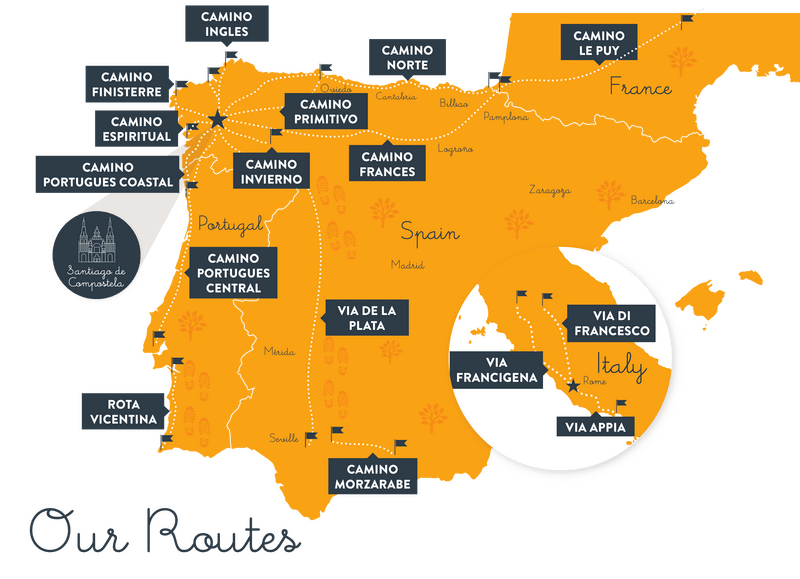
The Camino de Santiago is not a single trail but a network of more than 10 official pilgrimage routes that all converge at the Cathedral of Santiago de Compostela. Each route has its own character, distance, difficulty and history — from the bustling Camino Francés through northern Spain to the coastal beauty of the Camino Portugués, the rugged Camino del Norte along the Atlantic, or the long-distance Via Francigena from Canterbury to Rome.
The route you choose depends on how many days you have, your fitness level, the scenery you want to experience and how social or solitary you’d like your pilgrimage to be. Below is a quick comparison of the most popular Camino routes.
Not sure which route is right for you? Each Camino offers a completely different pilgrim experience. The Camino Francés remains the most-walked route — particularly its last 100 km from Sarria to Santiago, the classic first-timer choice. The Camino Portugués Coastal from Vigo is the second most popular starting point, offering gentler terrain and Atlantic views. For those seeking solitude, the Camino Primitivo and Camino del Norte are the most rewarding alternatives.
👉 Compare all Camino routes side by side — including distances, terrain, accommodation, and ideal walker profile — in our complete Camino de Santiago Routes Guide.

In 2025, 93% of pilgrims walked the Camino, while around 4% cycled the route — known as ‘Bicigrinos’ or ‘Bicigrinas’ (bike pilgrims). The rest completed it on horseback, by sailboat or in a wheelchair, according to the Pilgrim’s Office in Santiago.
Cycling the Camino allows you to experience the trail on two wheels and in turn, you cover more ground daily. However, you’ll need to cycle at least 200km to receive your Compostela certificate in Santiago (as opposed to 100km walking).
Hitting the trail on a mountain bike is a thrilling experience, but we only recommend it to experienced cyclists and those familiar with bike maintenance.
People of all ages and backgrounds walk and cycle the Camino routes each year. In 2025, pilgrims from more than 190 countries completed the Camino, with a record 530,919 Compostelas issued, according to the Pilgrim’s Office in Santiago.
Women make up the majority of pilgrims (53%), and the gender split has remained stable for years. Spaniards remain the largest national group (~42%), followed by Americans (8%), Italians, Germans, Portuguese and British pilgrims.
Motivations are also diverse: 46% walk for religious reasons, 33% for mixed religious and personal reasons, and 21% for purely non-religious purposes such as culture, fitness or self-discovery. Whatever the motivation, the Camino welcomes everyone.
Why should I walk the Camino de Santiago?
The Camino de Santiago attracts pilgrims from all over the world. A record 530,919 Compostela certificates were issued in 2025 — compared to just over 1,200 in 1985 — giving you an idea of how the Camino has grown into one of the world’s most popular pilgrimage routes, according to data from the Pilgrim’s Office in Santiago de Compostela.
The reason modern pilgrims walk the Camino ancient trail has evolved, and it’s now a rewarding experience for anyone who enjoys walking or cycling.
There are many ways to embark on this unique challenge and you will meet some wonderful people along the route and visit beautiful Spanish sites. Here are just a few things to enjoy along the way:
- Admire historic sites and monuments.
- With every Camino Way different, you can sample various cultures.
- Enjoy the various landscapes travelling across the country, from coastal Camino routes to vineyards, mountains, or tiny hamlets.
- Taste delicious tapas at every stopping point. In Galicia, they also have lovely pintxos to accompany your favourite evening drink.
- Meet other walkers worldwide and learn about their reasons for taking on this long-loved adventure.
- Discover yourself!
The beauty of the Camino routes is that you can walk as much or as little as you want; you could spend weeks walking from Le Puy to Santiago, one month walking from St Jean Pied de Port, a week or just a few days.
There is a Camino route for everyone but the one thing to keep in mind is that in order to receive your Compostela pilgrim certificate, you will need to walk at least the last 100km into Santiago de Compostela or cycle the last 200km.
You’ll also need to collect at least two stamps per day in your Pilgrim Passport during the final 100 km — usually obtained at albergues, churches, cafés and town halls — as official proof of your journey.
The best months to walk the Camino de Santiago are May, June, September and early October, when temperatures are mild (15–25°C), daylight hours are long, and the trail is busy enough to be social but not overcrowded. July and August are the hottest and most crowded months — daytime temperatures regularly exceed 30°C across Spain, and accommodation books out weeks in advance. Winter (December–February) is the quietest season but many albergues and rural hotels close, especially on the Camino del Norte and Camino Primitivo.
Camino de Santiago weather and crowds by month
| MonthWeatherCrowdsRecommended? | |||
| January | Cold, wet, possible snow in mountains | Very low | Experienced winter walkers only |
| February | Cold and rainy, short days | Very low | Experienced winter walkers only |
| March | Cool, variable, early spring | Low | Yes — services reopening |
| April |
Mild (10–18°C), spring blooms, occasional rain
| Moderate | Excellent | ||
| May | Mild to warm (15–22°C), green landscapes | High | ⭐ Best month |
| June | Warm (18–26°C), long days, busy | Very high | ⭐ Excellent |
| July | Hot (25–32°C), peak crowds, St James festivities | Very high | Avoid unless you book early |
| August | Very hot (28–35°C), crowded, Spanish holidays | Very high | Avoid |
| September | Warm (20–27°C), grape harvest in Galicia | High | ⭐ Best month |
| October | Cool (12–20°C), beautiful autumn colours | Moderate | Excellent (early Oct) |
| November | Cool to cold, rainy, short days | Low | Possible but check services |
| December | Cold, wet, many services closed | Very low | Experienced winter walkers only |
It depends on the route you choose. The full Camino Francés from Saint Jean Pied de Port takes around 5 weeks, while the last 100 km can be completed in about a week.
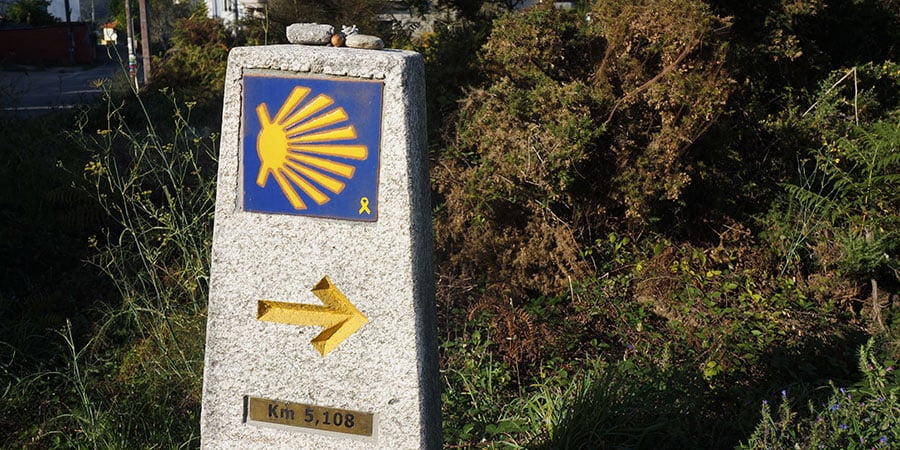
The Camino de Santiago trails are very well marked with scallop shells and Camino markings painted everywhere (trees, roads, walls…). All you have to do is simply follow the yellow arrows and they’ll guide you to Santiago de Compostela! In Galicia, you’ll also see stone waymarkers called mojones, which display the remaining distance to Santiago in kilometres — a satisfying countdown for every pilgrim approaching the Cathedral.
👉 If you’d like a personalised itinerary, try our Award Winning Camino Planner.